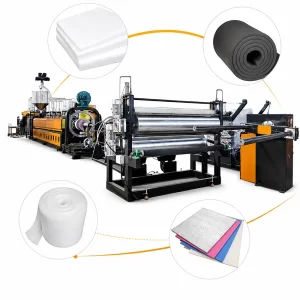

DEYI · EPE FOAM EXTRUSION
Find the configuration for your foam sheet
DY-EPE135 is an EPE foam sheet extrusion model with a published thickness range of 1–10 mm, width of 1000–2000 mm and output of 200–300 kg/h. Use these figures to prepare a project discussion; the required material, density, tolerances and configuration must be considered together.
1–10 mm
1000–2000 mm
200–300 kg/h
Where this model fits
DY-EPE135 lists 1–10 mm thickness and 200–300 kg/h output. It provides a comparison point between DY-EPE120 and DY-EPE150: all three list width up to 2000 mm, but their thickness and output ranges differ.
Technical specifications
Published model data. Installed power, dimensions and machine weight are approximate. Width, thickness and output must be confirmed together with material, density and configuration; the maximum values are not necessarily simultaneous.
Swipe or scroll sideways to view all columns
| Parameter | Unit | Value |
|---|---|---|
| Screw diameter / L/D | — | Φ135/55:1 |
| Screw speed | r/min | 5–45 |
| Expansion ratio | — | 20–48 |
| Sheet width | mm | 1000–2000 |
| Sheet thickness | mm | 1–10 |
| Cooling method | — | Water cooling |
| Output | kg/h | 200–300 |
| Installed power (approx.) | kW | 200 |
| Dimensions (approx., L × W × H) | m | 28×2.3×2.2 |
| Machine weight (approx.) | t | 12 |
The screw diameter/L/D entry is retained as published; its source does not give a separate diameter unit. Confirm the expansion-ratio measurement basis in the technical specification. Installed power is not measured electricity consumption, and equipment dimensions are not the total workshop space required.
How the EPE sheet line works
This is a physical-foaming, non-crosslinked polyethylene process. Material properties depend on the formulation and processing conditions and should be tested for the intended application.
Prepare materials
Prepare LDPE, talc, glycerol monostearate and other suitable additives to the agreed formulation. Confirm any reclaimed-material proportion against the finished-product requirements.
Melt and plasticize
The screw and barrel heat, plasticize and convey the material.
Meter and mix the blowing agent
The physical blowing agent is metered into the melt and mixed under the conditions specified for the equipment.
Extrude and expand
The melt expands after leaving the die to form the foam structure.
Cool and stabilize
The forming and cooling sections stabilize the sheet width, thickness and shape.
Haul off and wind
The cooled sheet is drawn off, flattened and wound into rolls for further processing.
Temperature, pressure, blowing-agent metering and haul-off settings must follow the model-specific process documents. This overview is not an operating procedure.
Define the complete supply scope
A line is configured around the extruder, blowing-agent and additive metering, die, forming and cooling sections, haul-off and winding. Mixing, filtration and screen changing, slitting and production-scrap recycling equipment can be matched to the project. Confirm winding method, drive controls, cooling arrangement and auxiliary equipment in the quotation.
Choose the downstream process
Film or foil lamination adds a facing to foam sheet. Foam-layer bonding builds thickness by joining foam layers. Pipes, rods, fruit nets and profiles require the corresponding dies or dedicated equipment; they are not products made simply by laminating and cutting sheet.
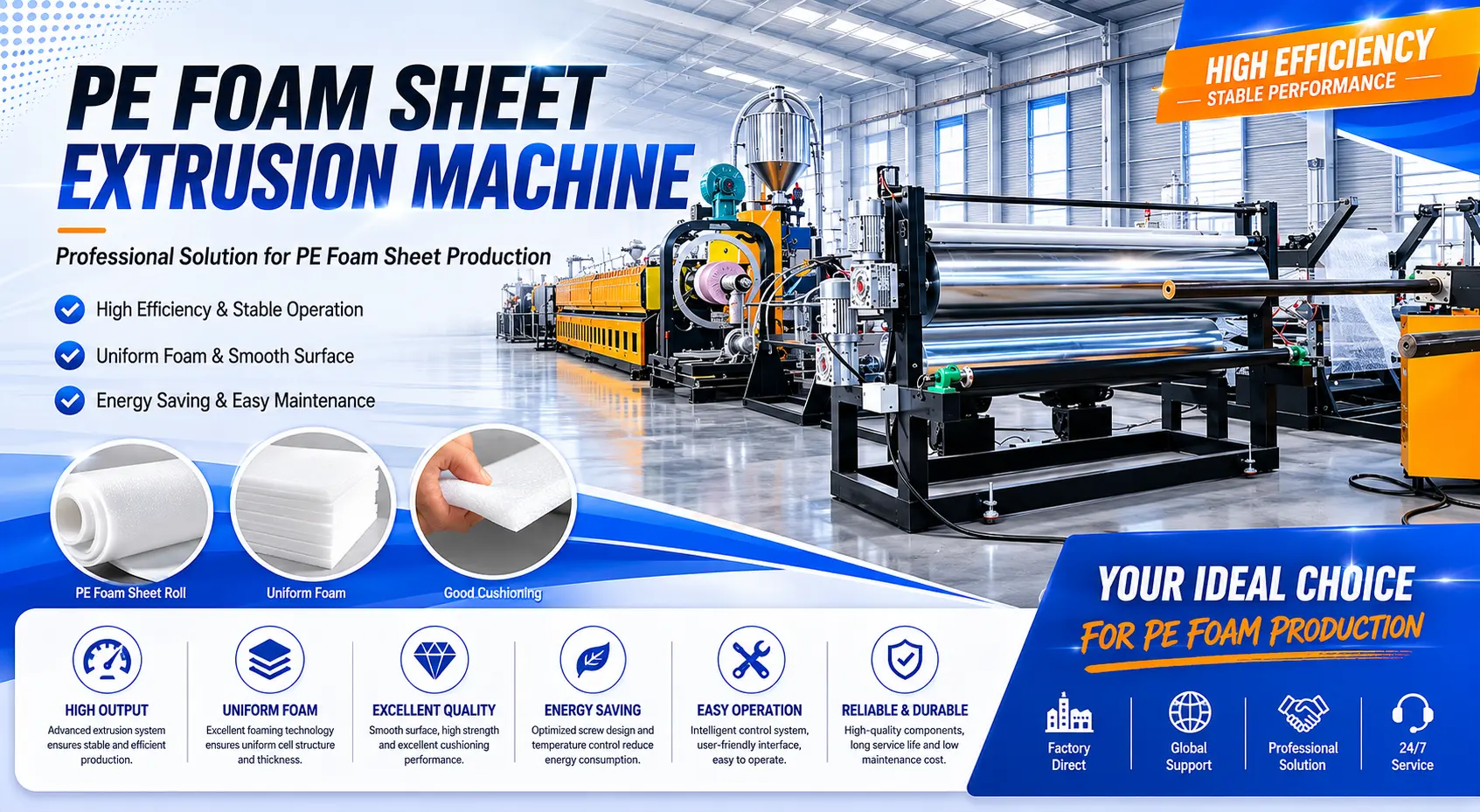
The existing series video is a general reference, not a model-specific acceptance test.
Prepare the project before requesting a quotation
- Product: application, sheet width, thickness, target density, tolerances, roll dimensions and required kg/h output.
- Materials: LDPE grade, formulation requirements, permitted reclaimed content and any facing or bonded-layer structure.
- Site: installation country, power supply, cooling-water conditions, equipment layout, access and operating space.
- Acceptance: agreed material, test duration, conditioning, measurement method, acceptable product output, scrap and utility-metering boundaries.
- Delivery: equipment and auxiliaries, exclusions, inspection, installation, commissioning, training, service arrangements and shipping terms.
EPE production may use flammable blowing agents such as butane. Qualified personnel must design and verify the gas supply, ventilation, detection, fire and explosion protection and static-control arrangements against the applicable requirements and agreed engineering documents.
Compare the DY-EPE range
Start with your required width and thickness, then compare output and installation requirements. Open a model for its complete specification and selection notes.
Swipe or scroll sideways to view all columns
| Model | Sheet width mm | Sheet thickness mm | Output kg/h | Installed power (approx.) kW |
|---|---|---|---|---|
| DY-EPE90 | 1000–1400 | 0.3–4.5 | 70–100 | 110 |
| DY-EPE105 | 1000–1800 | 0.3–6.5 | 80–120 | 130 |
| DY-EPE120 | 1000–2000 | 0.8–8 | 120–200 | 170 |
| DY-EPE135 | 1000–2000 | 1–10 | 200–300 | 200 |
| DY-EPE150 | 1000–2000 | 1–12 | 260–400 | 240 |
| DY-EPE170 | 1000–2000 | 2–16 | 400–500 | 285 |
| DY-EPE180 | 1000–2000 | 2–18 | 500–550 | 320 |
| DY-EPE200 | 1000–2000 | 3–20 | 500–650 | 350 |
| DY-EPE220 | 1000–2000 | 4–22 | 600–700 | 420 |
| DY-EPE250 | 1000–2000 | 4–25 | 800–900 | 480 |
Published model data. Installed power, dimensions and machine weight are approximate. Width, thickness and output must be confirmed together with material, density and configuration; the maximum values are not necessarily simultaneous.
Questions about this model
What output is listed for DY-EPE135?
The published output range is 200–300 kg/h. Confirm the required sheet width, thickness, density, material and configuration together. A catalogue range does not replace an agreed production test under defined conditions.
Can maximum width, thickness and output be achieved together?
Do not assume the maximum values are simultaneous. Provide the actual product specification and required output so the configuration and acceptance conditions can be agreed.
Does the installed power show actual electricity consumption?
No. Installed power is a nominal equipment figure. Running demand and energy per unit of acceptable product require measurements under defined production conditions and are not published here.
What determines the price and delivery time?
Request a project quotation covering the selected model, dies, cooling, winding, downstream equipment, installation and shipping. Price and delivery time depend on the agreed scope; this page does not publish a fixed price or guaranteed lead time.
What material and process does the line use?
The line uses LDPE as the main material in a physical-foaming, non-crosslinked polyethylene process. Confirm the grade, additives, blowing agent and finished-product requirements in the project specification.
Is EPE biodegradable or universally recyclable?
Do not assume polyethylene foam is biodegradable or accepted by every recycling service. Composition, cleanliness, films or coatings and local collection systems determine the appropriate recycling or disposal route.
Discuss your EPE project
Send your sheet specification, output target and installation conditions. We can discuss model selection and the equipment, testing and service scope to include in your quotation.
Model specifications and equipment descriptions are based on DEYI’s reviewed product information. Confirm the final supplied configuration in the technical agreement.